
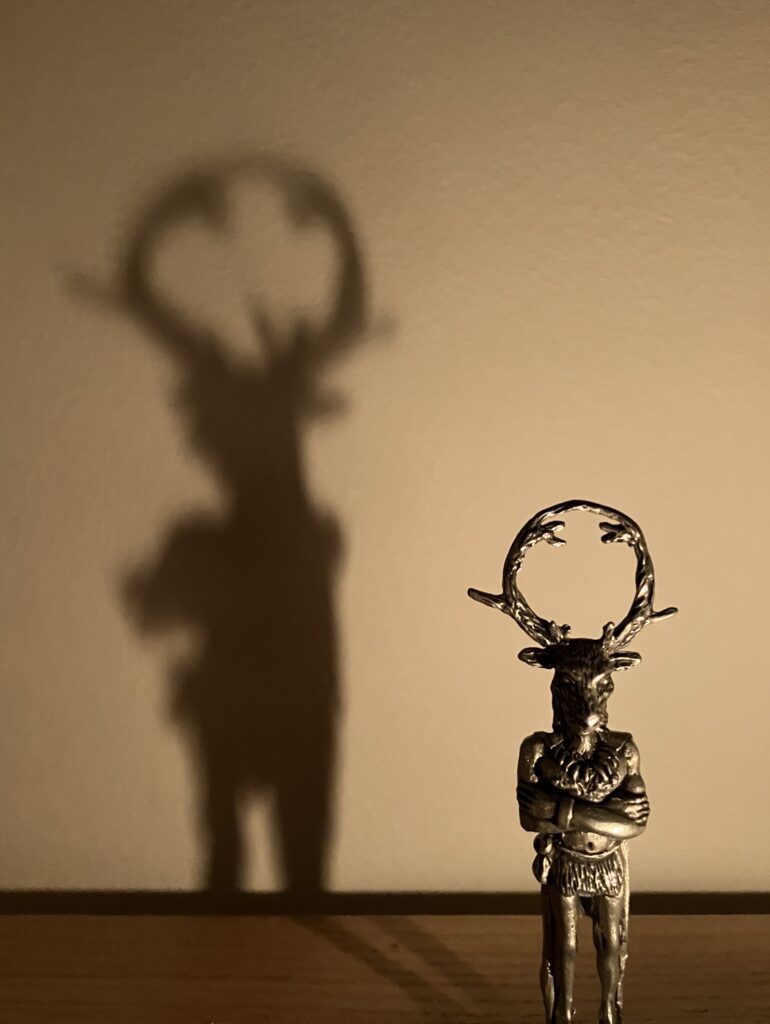
A couple of posts back I gave you an inadequate thumbnail sketch by way of introduction to my work in heathen tradition. Now I’m going to give you another, similarly scanty, addressing the other side of my spiritual practice – my work with the Horned God.
I first started my efforts to integrate him into my practice a little over three years ago. For quite some time I had felt a “pull” of sorts towards him, but it was the older, darker, primæval Horned God of traditional witchcraft that I was interested in, and not the tamed, de-balled character that neo-pagans frequently make of him – capering hey-nonny-nonny through pretty woodland and patting squirrels on the head, etc. I reacted against this “pull” because he was a figure alien to my heathen tradition, and carried on as I was, but the feeling persisted. I wanted to know more about him, his rôle in my life, who he was to me and what that meant, so finally, after careful consideration and checking with the gods, I decided that this was something I needed to pursue and set to carving out my own path.
To do this, I drew – and still draw – from three main sources: heathen ritual methods and frameworks which I already knew well and was already using, folkloric magic from English (though not specifically heathen) tradition, and various forms of traditional (i.e. non-wiccan) witchcraft. It probably sounds as if the result would be a bit of a hotchpotch, but in practice it dovetails better than you might think.
Here’s something of what I mean. Gemma Gary, in her book “Traditional Witchcraft: A Cornish Book of Ways”, presents the belief in her own tradition that the Bucca (the Horned God and primary deity) has a White aspect which rules the summer months of the year from Bealtaine to Samhain, and a Black aspect which rules the winter months from Samhain to Bealtaine. But coming at it from a heathen perspective, I don’t recognise the Celtic fire festivals; I work, as I’ve explained before, according to the Anglo-Saxon calendar, defined by the lunar months in relation to the solstices and equinoxes. So for me, the summer/White-aspect-ruled half of the year begins with the full moon of Eostremonaþ, the winter/Black-aspect-ruled half begins with the full moon of Wintermonaþ, and over the course of the year the two aspects – which I call the Bright and the Dark – take on different rôles and relationships to one another. Neither do I use a Celtic name for the God – or, indeed, any name. I simply call him “The Old One” – from the Old English “Se Ealda”, which as well as its literal meaning also implies “The Honoured One”, and indeed occurs as a euphemism for “The Devil”. As a primordial being, he predates any name because he predates anyone capable of naming. If he has a name, a true name, it’s not one we’d ever be able to pronounce, understand or even really hear – we’re simply not wired like that – so any name we use is going to be a title in a sense, and given by us, not to us. Which is why, for me, “the Old One” fits; however old you can imagine, no – he’s older than that!
Where ritual is concerned, I’ve also carried over the heathen practice of claiming, cleansing and hallowing the working space at the start of a ritual by carrying fire (i.e. a lit candle) around its perimeter a certain number of times while intoning a specific prayer (though not the same prayer as the one I use in acts of heathen worship) because that’s what I’m used to and find effective. In this way (although there’s much more to it, obviously) I’ve put together a practical foundation as a starting block from which I can continue to learn and progress. I do think it’s important to keep my heathen devotions and my work with the Old One separate, in the same way that I don’t use the runes outside a heathen context. The Old One isn’t a heathen god, so in my eyes it wouldn’t be appropriate to address him at my heathen altar, and l’ve set up another one for him specifically.
Did the Anglo-Saxons recognise the Old One? We can’t know. Any surviving written record from their era would have been written by christians anyway, so it would have been written with a christian slant (“Se Ealda”, remember?) and either not mentioned him or else distorted the facts. Popular modern theory posits a link between the Old One and Woden, in his aspect as Lord of the Wild Hunt; the Anglo-Saxons may not have thought in those terms. But to me, however, it doesn’t particularly matter. I’m a heathen who also honours the Old One, the Horned God, the Witchfather, whatever you want to call him. In my experience it fits, it works, I feel no conflict, my heathen gods say they have no problem with it, and the Old One himself doesn’t seem bothered one way or another.
It’s far from easy, and I never imagined it would be. There’s a lot of study and homework involved, drawing together numerous elements, cross-referencing, exploring, contemplation and, of course, practical suck-it-and-see. I’m effectively constructing my own path, which means putting each paving stone down one at a time before stepping on it. But’s that’s probably as it should be.