
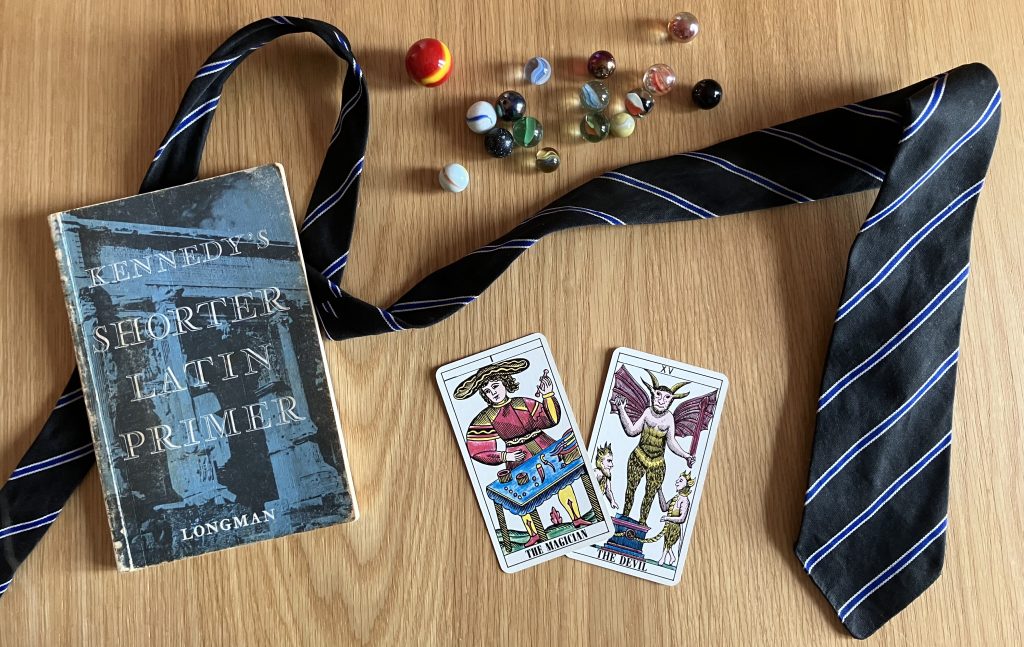
In the minor English public school I attended during the Eighties, “dabbling with the occult” was far from uncommon. From time to time the news would break, in excitedly scandalised whispers, about Pongo Perkins and Harewood Minor “doing a séance” in the Art Room, for instance. There was even a bit of a craze for such things now and again. I’m happy to own up that it was I who sparked a brief vogue for tarot reading among several of my contemporaries, but I should point out that it was someone else’s idea that we might start charging people fifteen pence a pop. (I know – bit cheeky of us.) I don’t know if this was true or not as I never bothered to check, but the word was that any form of occult practice was against the school rules, and that there had even been a couple of expulsions over it in the past. This, of course, just added to the attraction. We felt like rebels in a secret world of our own, and if we’d known the word “antinomian”, I’m sure we’d have used it non-stop.
Somewhat inevitably, the result of the excitement and glamour of rebellion combined with the then recently-hatched campaign among hysterical evangelical types to portray any form of magical involvement as EVIL! and NOT TO BE INDULGED IN! was that the average boy’s approach to the occult world ended up being drawn almost entirely from popular Devil-based horror films of the era, particularly “The Exorcist” and the “The Omen” series. Ten years before, perhaps it might have been “Rosemary’s Baby”, and ten years before that maybe Dennis Wheatley’s novels would have been our inspiration, though I imagine lots of schoolboy pretenders to the title of Ipsissimus would have ended up spitting on their blazers as a result of trying to pronounce the word. Nowadays, of course, half an unsupervised hour on the Internet would be enough for any curious third-former to source his information from a whole range of Satanist groups and organisations of varying degrees of legitimacy – LaVeyan, Setian, Theistic, Traditional, you name it – but in those days we had to make our own entertainment, damn it. The young’uns of today don’t know they’re born, etc., etc.
Whatever the source texts used, however, there were certain things that nearly always featured in the average young dabbler’s occult practice, to the extent that they could almost be described as the Five Pillars of Aren’t We Spooky:
(1) The Horned Hand sign. Beloved of American heavy metal poseurs of the era, and generally used in combination with a dark and forbidding stare as a greeting from one thirteen-year-old adept to another, despite its probable Italian origin as either an insult or a gesture made to keep the Evil Eye away.
(2) The number 666. To be written on anything and everything – desks, exercise books, wallet folders, the blackboard (where it will be wearily wiped away by a teacher two years off retirement who’s seen it all many times before) and yourself, as long as you can wash it off again before home-time if you’ve chosen to write it somewhere visible.
(3) Doing things the wrong way round. The upside-down cross was always popular (we had no idea that it’s still a christian symbol – “St Peter’s Cross” – even when it’s that way up) but the biggie was, of course, the “lord’s prayer” chanted backwards. There was much discussion about whether “backwards” meant that just the order of the words had to be backwards, or if you were supposed to spell the words backwards too – or, for extra punch, whether doing it properly required using the Latin version. Playing records backwards to hear the secret sinister messages hidden on them was a little bit impracticable for most, but someone had usually heard second-hand that someone’s older brother had tried it on his parents’ record player, and it had inexplicably (or maybe not?) broken! Gasp!
(4) Sticking pins into a waxen doll. Well, it was easier to use Plasticine than to melt down the wax and get creative with it, to be honest. Or there was Blu-Tak.
(5) The Ouija Board. (Usually pronounced, and indeed often spelled, “Weegie”, though I doubt the people of Glasgow feel very happy about that.) A big hand, please, for everyone’s favourite Victorian parlour game – not the mass-market kind patented by Hasbro Games or the more baroque creations you see sold today in witchy shops, but the low-to-zero-budget version, made in moments out of a plastic cup from the water cooler and some squares of paper torn from a couple of sheets of your A4 refill pad with the letters of the alphabet written on them. Arrange the letters in a circle on a table, put the cup in the middle, and evil spirits will come flocking to spell out loads of spooky gibberish and, if you’re very lucky, throw a book or two around the classroom. If only Abramelin the Mage had known it was such an easy business to get the spirits to bend unto thy will, he needn’t have bothered with all those months of teetotal chastity and prayer.
How much of all this was I involved in? Not very much, I’m afraid. I had already done my background reading, and even from studying the pop-occult books that were on my stepfather’s bookshelves at the time I knew that there was a lot more to learn about out there in the occult field than was generally known to the layman. I read “The Satanic Bible” in my mid-teens, and found it… a bit disappointing, to be honest. Its approach to magical ceremonial was flamboyantly Wheatley-retro, but it made it feel a bit like pantomime, and most of the philosophy set forth in it seemed a bit too obvious to need stating. (To be fair, this was in Great Britain in the Eighties, and if you were there at the time and have read the book in question you’ll know just what I mean. It was probably ground-breaking in Sixties America, though.) However, there were some very unexpected books in the school library which were of interest. Gustav Davidson’s “Dictionary of Angels, Including the Fallen Angels” (with numerous angelic sigils and quite a few old-school ritual incantations in the appendix), Richard Cavendish’s “The Tarot”, three or four academic books on astrology, including one which went into some detail on the forms taken by the planetary spirits… if it was really against school rules for the pupils to “dabble in the occult”, what the hell were these volumes doing in the school library? (I should add at this stage, by the way, that no, I did not attend Sunnydale High or Hogwarts.)
The school described itself as church of England-oriented when it came to religious matters, but in practice, outside of morning assembly it ran more along what we’d now call “culturally christian” lines, with any noticeable religiosity thought rather out of place. It certainly didn’t stick with me, or even gain a real foothold to start with; I’d already realised that christianity and its god didn’t meet my needs, and the answers I was looking for were better sought elsewhere. It wasn’t as if I didn’t try. At the last assembly of every term we sang a hymn that went, from unreliable memory: “God be with you ‘til we meet again/ May he through life’s storms direct you/ And (rhubarb rhubarb can’t remember) protect you/ God be with you ‘til we meet again.” And I would be singing along with the rest, thinking, yes, may he protect me; maybe this time he will. Then, at the end of the day, I was off back home, where my abuser would have me to herself all day for the next six weeks. So, sorry, “god”, but no thanks. I wasn’t signing up to be anyone’s bloody sunbeam.
What draws a bunch of nice (which we weren’t) unremarkable schoolboys (which we were, mostly) to experiments – however ham-fisted and spurious – in the Secret Arts? For my part, I was a big weirdo from the off – I’d been “bitten by the Serpent” in childhood – but for most, I’d guess, the answer’s easy. As I’ve said, it was the excitement. All boys crave excitement, in whatever form, and whereas some find it in ways sanctioned by the adults in charge (rugby! cricket! athletics! decent manly competitive sportiness!) and are thus deemed Good Honest Healthy Chaps, some find it in ways that fly in the face of the expected standards. I need hardly mention sex here – I, of course, had the same yearnings for some of the older boys as any rightly constructed adolescent gay kid, but I never “saw action”. But then, I was a day pupil rather than a boarder, and under no illusions about my lack of attractiveness; though who knows what unbridled debaucheries might have gone on in the school dormitories after lights out? Magic, on the other hand… not manly, not godly, not “natural”, approved of or even allowed… now you’re talking! Where can I buy black candles, anyone know?
Whether this sort of thing ever becomes anything more than experimental teenage thrill-seeking, of course, is a matter for the individual involved and his own wyrd. I don’t know if any of the people I knew at school who were interested in the subject at the time took it any further in later life or not; one in particular, I think, might have done, but I suspect the rest lost interest quite quickly. Either way, given that I’ve got no intention of ever attending anything as naff or sentimental as a school reunion – gods, no! – I shall probably never find out.