
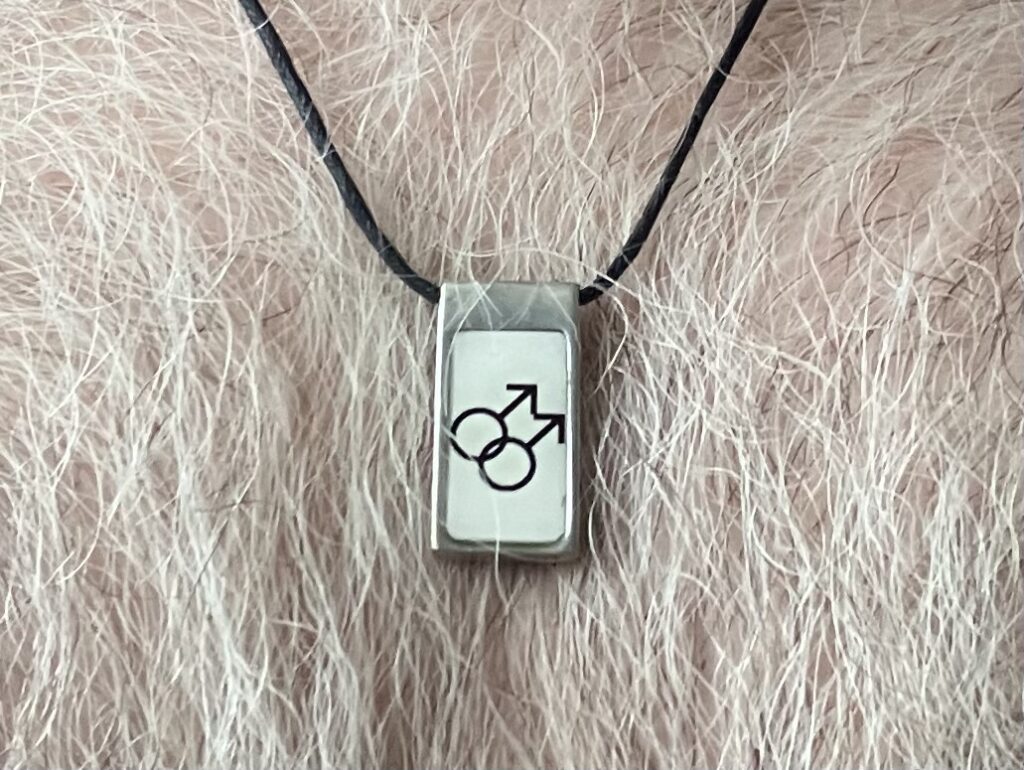
Some years ago now, at a fairly large gathering at which my husband was DJ-ing (for “mates’ rates”, I should add, or as you and I would put it, “unpaid”) I was introduced to somebody with the words, “This is Tony. He’s a queer pagan too!” Being English, and hence cursed from birth with the Not Wishing To Make A Fuss gene, I reigned in my instinctive teeth-on-edge reaction and said only, “Yeah, I’d say “gay” pagan. Hey.”
However…
I’m a man attracted exclusively to my own sex, the word for which is “homosexual”, or – in everyday language – “gay”. Accordingly, “gay” is my chosen description of myself. It is not, and indeed never will be, “queer”.
I hate the word. I grew up in the 1970s and 80s, and I have an unpleasant history with it. Apart from that, in its present day context there’s an echo of the aggressively sulky teenager about it – “Yeah? You gonna make sumfin’ of it?” – when, as all know, aggressively sulky teenagers are only aggressively sulky because they know deep down that they’re safe to act that way. It couldn’t really be otherwise, given that the word has been taken up across the media as one that’s OK to use nowadays. The professional prescribers of public opinion have made it so, and they aren’t concerned with what we who refuse the description might think.
It all comes down, largely, to a concept the “queer-identified” know very well, and will present lectures about at the drop of no hats: “privilege”. At the risk of sounding ancient – but fuck it, why stop now? – they’re, in the main, simply too young to recognise their own position of privilege where the word “queer” is concerned. They live in a secure enough position (which is great) that they feel they need neither know nor care what earlier generations of gay men and lesbians had to live through (which isn’t), and have picked a word that makes them feel all edgy and bad-ass, egged on by bubble-dwelling soi-disant “intellectuals” and “academics” who have an ideology to propagate, money to make out of it and no concern that they’ll have to live with its possible results. For both it’s all surface, because for them, the word is safe; just a word like any other, with no personal negative psychological history attached to it. They never had it sneered at them in angry disgust by family members or people they had thought of as friends. They never heard, “Well, he was a queer, wasn’t he?” when the news announced the death from AIDS-related illness of the latest gay male celebrity to succumb. They never saw it used, almost daily, to describe them in the gutter press, along with other words like “poof”, “pervert” or “shirt-lifter”. They never knew what it was like to have it shouted at them across the street, or while they were being chased down it on their way to being overpowered and kicked unconscious in the gutter. They talk about “reclaiming the slur”. No. Not yours to reclaim, my darlings. You weren’t there, and you don’t get to apply it, without asking permission, to those who were. Stop it.
“Oh, but Tony,” comes the objection, “it’s about inclusion.” Well, no, actually it isn’t, because there’s only one kind of person it includes – the ones who have taken “queer” ideology on board, along with its assumptions, politics and aims. Because “queer” is an ideology which people voluntarily buy into and position themselves within. As a description of people it’s broad to the point of meaningless, and – because of its lack of roots in people’s actual experience – shallow as a puddle. There is, for instance, nothing you can point at and say, “That is queer history”, despite the present popularity of that expression. The histories of the experiences of gay men, lesbians, bisexual people (to the degree that they positioned themselves as part of these) and transsexual people – those, you can define; those, you can describe. But “queer history” covers none of these things, by attempting to cover – and, indeed, reinterpret and redefine – all of them. It’s, at best, a fudge. If you tell me that you’re “queer”, that doesn’t convey much; I’m going to need more information before I understand what you’re talking about, in much the same way as there’s no such thing as a language called “Foreign”. Diversity isn’t the point, either. Whichever letter in the ever-growing initialism might be “yours”, you’re expected to get in the Q. All hail the happy hivemind, which we’ve decided is a thing now! You don’t want to be a hater, do you?
If you think I’m exaggerating, try this. Imagine expecting every religious minority – Jewish, Hindu, Muslim, Buddhist, all forms of paganism, the lot – to ignore their cultural differences and often contradictory convictions and motivations in life in favour of defining themselves as simply “separate from and in opposition to the oppressive religious majority”. Now explain to me why it’s acceptable to use, as shorthand for “separate from and in opposition to the oppressive religious majority”, the word “Kike”, and why it’s in any way surprising that Jews in particular might have a problem with that.
The word “queer” could and should have been left to die. There are loads of people who, like me, have long experience of seeing and hearing it used as a term of abuse directed pretty much entirely at gay men, or men suspected of being gay. The repurposing of the word as the name of a movement continues that abuse by requiring us to accept it as a term for ourselves, and is thus inherently homophobic, but name-calling is just the start of it. We’re expected to join the merry band, but treated with sneering contempt if we don’t march in lockstep with it, and now and again with the open expression of fantasies of violent punishment for breaking ranks. The evidence for this isn’t that hard to find on-line, if you doubt me. The homophobia, now, is often coming from inside the house.
So, this is me, saying – and meaning – “No”. I am not “queer”. The word is unacceptable, and no wide-eyed attempt at gaslighting from some performatively nail-varnished straight boy who enjoys getting pegged by his girlfriend – now that it’s safe for him to be that – is going to change my mind. Because we all know that if events ever take a sudden nasty turn and it stops being safe, he’ll immediately chuck the word and all its implications far away like the burning paper bag of shit left on the doorstep that for some of us it always was, don’t we?