
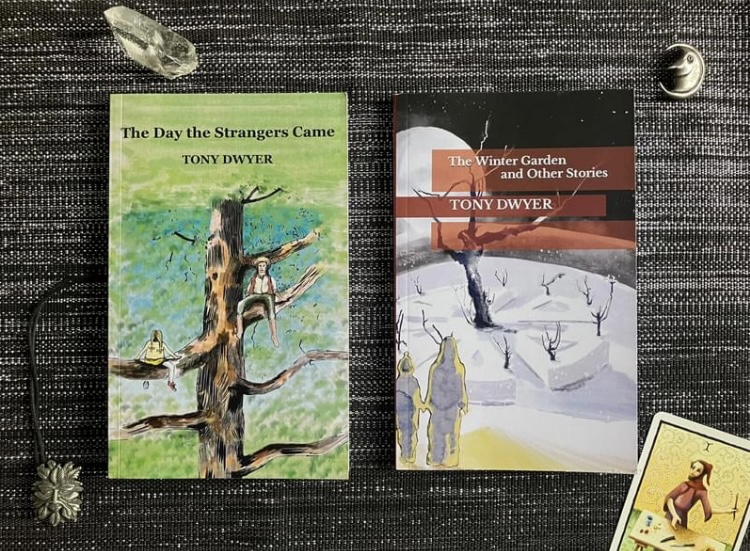
As explained in my “about me” blurb, I’ve written a couple of books, and here they are.
“The Day the Strangers Came” is a short novel in which a young girl finds herself unexpectedly mixed up in the affairs of elves; it features a slightly dodgy trickster who watches at the boundary between our world and theirs, a beautiful young “fairy godmother” character, a disturbing discovery about her own family, an enchanted forest, and a boo-hiss villain heading for some well-deserved comeuppance. “The Winter Garden and Other Stories”, on the other hand, has four short stories, centred on the idea of witches. In these, an ancient English legend is reawakened, bringing danger with it; a teenaged girl struggles to come to terms with the death of her beloved grandfather who taught her lessons in the Craft; a small group of squabbling boys accidentally piss off the wrong strange old woman who lives down the lane; and a boy’s life takes an unexpected turn when he catches a glimpse of another world.
Yes, they’re fantasies, or fairy tales, set in the modern day but belonging to that tradition, with a basis in English folklore. But, although the main characters in them are children, they’re not written only for children. And I will tell you why.
During my efforts to hawk my books at craft fairs, I’m almost always asked the same question – “What age group are they for?” – and it’s one I don’t like answering. For one thing, it’s reductive; you can’t assume that all children of a certain age are interested in the same things and want to read the same things. “Oh, that’s just for children” – stop right there. So what? Why shouldn’t adults read fantasies, if they enjoy them? I can tell you that a lot of adults have bought my books to read themselves, saying, “Oh, this looks right up my street; I love all that.” I also once met a customer – a boy of eleven-going-on-fifty – who announced, in patrician tones, “Well, I’m not really a reader, but I will buy it, because I believe in supporting local authors.” Bless him!
Many of the books that were important to me as a kid are still among my favourites now, and I don’t give a crap if that makes me look as if I’ve never grown up. Edith Nesbit, Diana Wynne Jones, Alan Garner’s early books… fantastic. Books read in your childhood, when they’re well done, can stay with you for life. The way you read them changes; you find a story behind the story, of the characters and their relationships, that you missed as a child, and parts where the writer pokes fun – however gently – at adult absurdities. (Yes, Miss Nesbit, I am looking at you.)
There’s another side to this. Someone who writes for and about children has to stay in touch with his “child mind” in a way that most adults possibly don’t, because a child reader needs to feel that the author is on his side, and understands certain things about his world that the adults around him are unaware of. Because – and this is why Mum and Dad tend to be bundled smartly away into the background before anything significant happens in children’s books – adults, when you’re a child, don’t get it. Being told “That’s too old for you, dear” is frequently not helpful, because while adults often think they know what worries or unsettles children and can shield them from it, the things that are actually going on for them, which they don’t want to talk about, can remain unaddressed. There’s a vein of darkness running through life, of things feared and not understood, and not all endings are neat or happy. Children understand this more than adults think they might, and they respond to seeing that others understand it as well; I’d argue that they need that. There are things that, while they might make them nervous, they want to look at, to face and puzzle out in the safe context of the world of story, and if they learn that there’s hope to be found in an ending that’s less than “happy ever after”, that’s important too.
I’d never for a moment claim to be a “great writer”; I’m just some bloke, writing the stories that tell me they want to be told. If people are up for that, young or not-so-young, I’m always delighted. If they enjoy them when they read them – and, going by the Amazon reviews, they do, both adults and children – then that’s even better. Because it shows me that there’s still some space for magic in people’s lives, and I love to be part of that.