
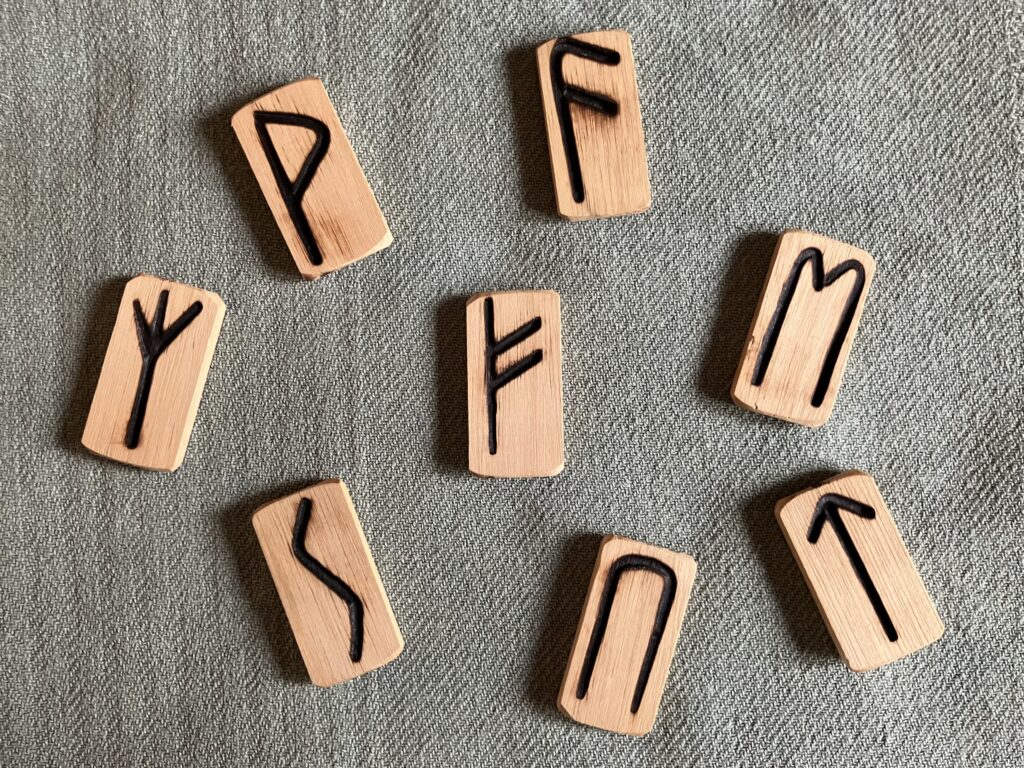
OK – runes, then. Big subject, and one I’m going to have to split up into several posts. It’s not my intention to teach you here how to use them; what I do hope to convey, though, is the way I work with them, for both oracular and magical purposes, so I’ll probably be showing you examples of my approach in the future. And before somebody pops up to object, “Oh, but rune magic is a modern invention…” Yeah, yeah – zip it, Zippy. Hear me out and you’ll see where I’m coming from.
A messy and oversimplified history lesson first. Runology (let’s call it that) started in the early seventeenth century with the writings of a Swedish mystic and polymath called Johannes Bureus. (So, you see, it’s not as modern as all that – the earliest discovered list of meanings recorded for the tarot cards has been dated to about a century later.) He adapted the Younger, or Norse, rune-row by dropping one of its sixteen runes and interpreting the rest according to the esoteric thought of the time, among other things attributing seven of them to the seven classical planets and seven stages of initiation. Then, in the early twentieth century during the occult revival in Germany, an Austrian occultist called Guido List added the aristocratic “von” to his surname (which was cheeky) and two extra runes to the Younger rune-row, creating his own interpretation tying into Ariosophy, a nationalist esoteric system that was current at the time. List’s version of the runes was later strip-mined by Heinrich Himmler, who integrated aspects of it into Nazi symbolism and philosophy. Sad little twat.
Popular runology didn’t really take off in the English-speaking world until the publication of Ralph Blum’s “The Book of Runes” in 1982. Until that, most people who had heard of runes only knew of them in the context of Tolkien’s fiction. (I can still remember the fascination with which I first saw the brief note about them in “The Hobbit” and knew at once that there was more to them than I was being told.) Unfortunately, Mr Blum’s book… well, to be frank he didn’t know what he was doing. Working with the twenty-four runes of the Elder, or Germanic, rune-row, he added in the spare blank from his set as a twenty-fifth (which he called (“Odin’s Rune”), put them in a new order and used the I Ching to help him work out new interpretations. But people loved what he came up with, and it effectively brought the runes into public consciousness (at least, as I say, in the English-speaking world) for the first time. This was not altogether a good thing, because it meant the New Age bods got their dainty paws on them and co-opted them for their own love-and-light-infested purposes, whatever those might happen to be. I’ve never forgotten a talk at a psychic fair I once went to, given by a large frizzy woman in an incredibly purple dress and far too much amber jewellery, who said the runes were “created by the ancient druids” and that “in an Egyptian rune reading, this one would represent the Tree of Life…” SHUT UP!
By this stage you’ll have cottoned on to the fact that none of these people are “reading the runes” so much as “reading into the runes” – i.e. approaching them with fixed ideas of their own which have little or no link with their origins, and then plastering their own ideas and ideologies on top of them; nationalism, feminist spirituality, chakras, some drivel about Atlantis… anything but looking properly into what we know about them from historical sources. And this is not the way to go about it, because then you’re telling the runes what they are, rather than letting them tell you.
The historical written lore (and we heathens are all about that) is scant when it comes to the runes, but what there is is valuable. Introducing, with a flourish of trumpets, the three Rune Poems: the Anglo-Saxon (which covers the twenty-nine-rune Anglo-Saxon rune-row), and the Old Icelandic and Old Norwegian poems (both of which cover the sixteen-rune Younger, Norse rune-row.) We immediately hit a snag here, because most people’s rune-row of choice these days is the twenty-four-rune Elder, Germanic one – and it has no rune poem of its own; it almost certainly never did, but if there was one, it hasn’t come down to us. So, people in search of a more historically authentic interpretation of it (rather than pulling one out of their wishful-thinking arses) settle for one based on juggling the Anglo-Saxon and Norse ones, while ignoring the five Anglo-Saxon runes that don’t appear in the Elder row. You can do this of course, and many, if not most, people do; but, since my practice is based on Anglo-Saxon roots, I go straight to the full Anglo-Saxon rune-row and its accompanying poem, while keeping the Norse poems in mind for further information, particularly where the Anglo-Saxon poem has been partly “christianised” to disguise the runes’ non-christian origins.
Here’s an example. The first rune, in all the rows, is the one positioned right in the middle of my picture, with two “branches” slanting upward from the vertical “stem”. This is the rune representing the F sound, and it’s called “feoh” in the Anglo-Saxon row and “fé” in the Old Norse row. Both these words mean “cattle” or “livestock”, and by extension, “money” or “wealth” (the modern English word derived from the Old English is “fee”.) Here are the relevant verses from the three poems:
(Anglo-Saxon) – “Wealth is a comfort to all men, but he must share it who would cast his lot for judgment before his lord.”
(Old Icelandic) – “Wealth is a source of strife among kinsmen, the fire of the sea, and the serpent’s path.”
(Old Norwegian) – “Wealth is a source of strife among kinsmen; the wolf grows up in the forest.”
So, in each case we’re presented with the idea of “wealth” and then told something about it. This is the ”money in the bank” rune, and people get excited when they see it, but the Anglo-Saxon verse reminds you to be generous with it if you’re going to be well thought of by others, and the two Norse poems observe that family conflicts often arise because of money issues. It’s the “serpent’s path” because it can attract envy, and the line about the “wolf” warns that greedy people might be lying in wait to relieve you of it. (The “fire of the sea”, meanwhile, is a kenning – a poetic figure of speech – that means “gold”. Think of the sunlight glittering on the sea, like gold coins.)
Let’s look closer. In Anglo-Saxon times, a family’s wealth was measured by its cattle. The bigger the herd, the wealthier; with cattle you have milk, meat and hide – some for your family, some to trade with others – and if you breed them well, you can increase what you have. If you have enough that you can afford to be generous – as in the poem – you can share with friends, who can share what they have with you in turn. Indeed, a small community would depend on cooperation of that nature to thrive, and ultimately to survive. But if you have cattle and you do nothing with them, you’re wasting that potential, instead of putting it to work and prospering from it; hoarding your wealth for the sake of it doesn’t help you or anyone. On a more metaphorical level, the advice of this rune goes for other kinds of resources you might have, like knowledge or talent. Don’t let them go to waste – make them work for you, and (if you can) for others.
That’s a beginning, but you can see how it works. Studying the rune poems tells you not just what each rune represents, but more broadly what it actually means, with the many implications and pieces of advice associated with it. If you’re doing a rune reading, “feoh” can simply announce the presence or arrival of money (or draw your attention to your inner resources) or it can come with a warning, depending on the runes that accompany it. (Despite what a lot of people will tell you, you can’t really do a proper reading by drawing a single rune. Nobody speaks a language one word at a time.) Again, in magic, “feoh” can be used to attract money – and it is! – but also to protect it, for success in trading with it, for matters of inheritance, or to help bring you confidence in your own inner resources. It all depends, as with readings, on the runes you use along with it, to bring out and focus in on the right shade of its meaning.
This is how you work out what the runes mean to you. It takes study, meditation and a readiness to think in the terms and with the values of a society centuries old, and, following on from that, what they mean for us today. It’s a long job, which can’t be rushed, and you never stop learning; but in the long run it’s worth the work you put in, and for those drawn to the runes, in my eyes it’s the truest way to learn how they speak to you, and how you can bring about change through them.
More on the subject to come – probably not in my next post, but come it will.